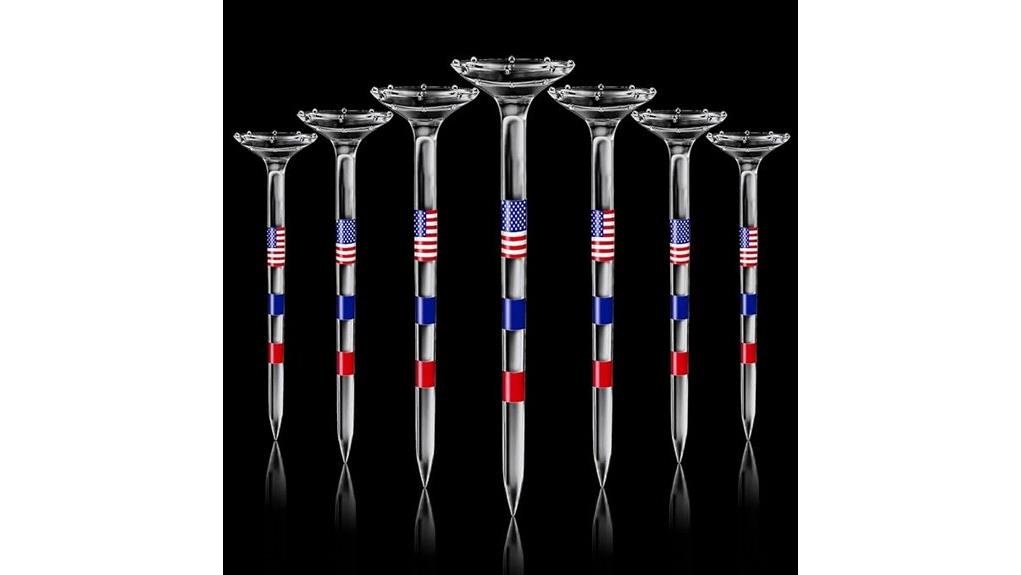
You’ll like these 3 1/4” unbreakable plastic tees if you want steadier launches and fewer snaps. The big cup cradles the ball for a larger contact area while the 8-prong tip flexes to cut drag and preserve clubhead speed, often adding yards and tightening dispersion. Durable plastic resists bending much better than wood and feels firm yet slightly springy. Colored rings give fast height references. Keep going for specifics on packs, colors, and setup tips.
Some Key Takeaways
- Large 3¼” plastic tee with big cup and 8-prong tip delivers steady ball support and larger contact area for consistent launches.
- 8-prong flexible tip reduces contact resistance and drag, preserving clubhead speed and often adding a few yards.
- High-quality plastic resists bending and breakage, lasting multiple rounds compared with wooden tees.
- Colored rings provide quick visual height guides for repeatable setup and faster pre-shot routine calibration.
- Available in 50- and 80-packs and multiple colors (including USA flag), suited for practice, teams, and on-course use.
What These 3 1/4 Unbreakable Plastic Tees Are and Who They Suit
Think of these 3 1/4″ unbreakable plastic tees as rugged, low-maintenance replacements for wooden tees—you’ll get consistent height, sturdy support, and far less breakage. You’ll appreciate their durable plastic, color options, and pack sizes (50 or 80) that fit your routine. They suit beginner golfers seeking reliability and confidence, and more experienced players who want uniform setup. Big cup and 8-prong details aid placement and stability without overcomplicating use. Course compatibility is strong: length works for drivers on most tee boxes, and colors help standardize height. You’ll join others who value consistency and low upkeep. These essentials are exactly the sort of basic golf tees every golfer will appreciate.
How the Big Cup and 8-Prong Tip Affect Ball Contact and Distance
Now that you know these tees give consistent height and durability, consider how their big cup and 8-prong tip change ball contact and distance. You’ll notice the big cup cradles the ball for steady support, promoting impact stability through a larger contact area. The 8-prong tip flexes on strike, minimizing contact resistance and delivering reduced drag that helps preserve clubhead speed. Together they foster launch consistency and more predictable trajectories, while the tip’s give can lead to measurable spin reduction on off-center hits. If you want reliable tee performance, this design tightens dispersion and often adds a few yards. Many golfers pair such tees with practice balls to refine launch and accuracy during training.
Durability and Feel: Plastic vs. Wood-Real-World Resistance to Bending and Breakage
Grab a plastic tee and you’ll immediately notice it’s built to last compared with wood: the high-quality plastic resists bending and won’t snap under typical driver impacts, so you’ll spend less time replacing tees and more time playing. You’ll appreciate material longevity across rounds; dozens of drives leave these tees intact while wooden ones splinter. Tactile feedback differs—you feel a firmer, slightly springy response at setup and impact, which reinforces confidence in your equipment. As part of your group of players, you’ll value reliability and consistent performance. The net result: fewer interruptions, predictable behavior, and shared satisfaction on the course. Perfect Golf Tee Picks for every golfer offers a variety of tee assortments to match different preferences and playing styles.
Using the Colored Rings as Tee-Height Guides for Consistent Shots
Frequently, you’ll rely on the colored rings on these tees as quick, visual height markers to set consistent ball position for every club. You align a specific ring to the turf, creating a repeatable reference that simplifies pre-shot routine and builds team-like confidence in practice. This visual calibration cuts guesswork, speeds setup, and helps enforce a consistent setup across drivers and woods. Measure once, pick a ring, and everyone in your group can match it. Evaluate how each ring affects launch and spin during range sessions, then commit to the best marker for your swing for reliable, repeatable results. Practice with a quality golf practice mat can help you translate those same consistent setup habits from the range to course-like conditions.
Buying Guide: Pack Options, Colors (Including USA Flag), and When to Choose These Tees
Although you can buy these tees in bulk for convenience, choose the pack size and color that match how and where you play: pick the 80-pack if you practice frequently or run a team, and the 50-pack if you play casually or want to trial different setups; select bright colors for visibility in long grass or low light, neutral tones if you prefer a low-profile look, and the American flag option for patriotism or event-specific branding. You’ll appreciate the unbreakable plastic, big cup and 8-prong tip for consistent drives. Match pack sizes and flag designs to purpose: practice, play, or show team pride. Consider pairing your tees with an essential golf towel to keep clubs and grips clean during rounds.
Some Questions Answered
Do These Tees Work on Artificial Turf or Driving Mats?
Yes — they’ll work on artificial turf and driving mats. You’ll find the flexible 8-prong tip won’t tear mats, preserving mat durability while providing reliable tee alignment. You’ll insert them more easily than wooden tees and they stay upright under drives, giving consistent contact and reduced friction. You’ll appreciate the colored rings for repeatable height and the sturdy plastic that resists bending, so you’ll feel confident and part of the practice community.
Are They Permitted in Tournament Play Under Golf Rules?
Yes — they’re allowed in most competitions. You’ll want an equipment legality check, but the Rules of Golf permit teeing devices that don’t improve your club’s performance, so these plastic tees generally meet rules clarification standards. They’re durable, consistent, and won’t give an unfair advantage beyond normal tee benefits. Still, confirm local committee limits or specific tournament policies so you and your group feel confident and included.
Do They Float for Water Hazard Retrieval?
Yes — they float if made from buoyant materials, but you should do float testing to be sure. You’ll find most high-quality plastic tees stay on the surface, easing water hazard retrieval and saving you frustration. Test a few colors and ages; faded or cracked pieces may sink. You’ll join others who rely on buoyant gear when you confirm consistency, then trust these tees during wet-course trouble shots.
Are They Recyclable or Made From Recycled Plastic?
No — they’re not marketed as containing recycled content, and they don’t claim post-consumer resin. You should check packaging or seller specs if you want confirmation. For recycling guidelines, most municipal programs don’t accept small mixed plastics like tees, so you’ll likely need to dispose of them in general waste or seek specialized plastic recycling centers. You’ll feel better asking the seller for material data or requesting a recycled option.
Can the 8-Prong Tip Damage Practice Mats?
Unlikely — the 8-prong tip’s tip flexibility and rounded prongs minimize damage to practice mats. You’ll notice less snagging compared with rigid tees, and the grip texture on the stem helps the tee stay put without tearing turf. If you’re cautious, test on a scrap mat; heavy misuse or repeated swings at the same spot could still abrade vulnerable surfaces. Overall, it’s mat-friendly for most golfers wanting reliable practice.