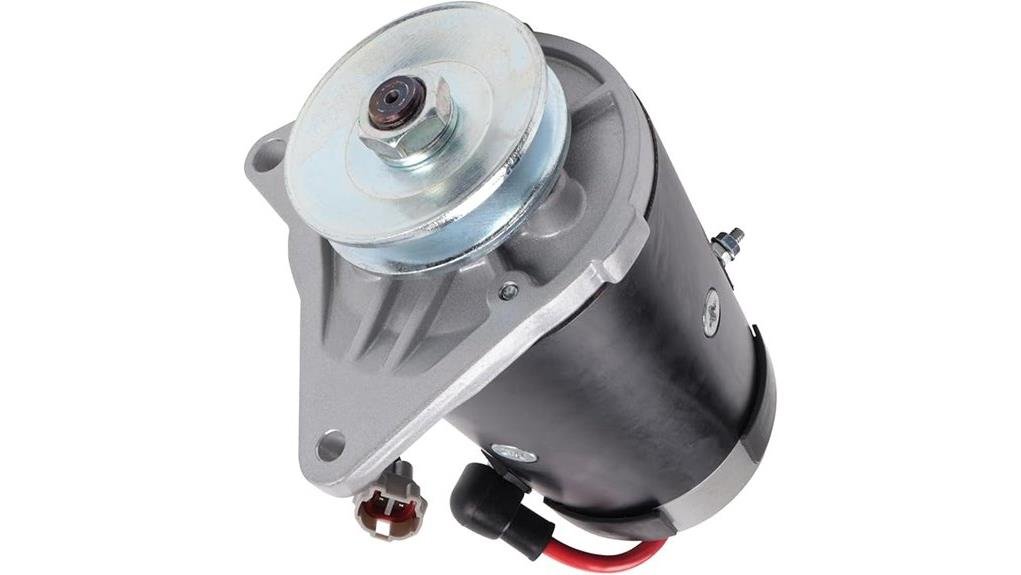
You’ll get a 12V, 23A starter-generator built to fit Yamaha G-series carts (G16–G22) from 1996–2003, matching Club Car DS–type mounts, V1 pulley, EF cooling fan and ER regulator for correct belt tracking and thermal control. Confirm part numbers (e.g., 420-44001, GSB107-06, JN6-H1100-00-00) and spline/key engagement before install, verify grounding and charging circuits, and follow torque/clearance specs; continue for fitment, installation and troubleshooting details.
Some Key Takeaways
- Confirms fit for Yamaha G-series (G16–G22) model years 1996–2003; verify G-series identifier before purchase.
- 12V, 23A unit with V1 pulley, EF cooling fan, and ER regulator matches electrical and cooling requirements.
- Cross-reference part numbers (420-44001, GSB107-06, JN6-H1100-00-00, MOT-2001, AM135707, SG-803) to ensure compatibility.
- Inspect mounting tab spacing, splines, nose clearance, and bolt torque to guarantee correct mechanical fitment.
- Test insulation, polarity, and output post-installation; keep warranty docs and contact seller within 8 business hours if issues arise.
Which Yamaha G-Series Models and Years Does This Starter Generator Fit?
This starter generator fits Yamaha G-series golf carts manufactured from 1996 through 2003—specifically models G16, G17, G18, G19, G20, G21, and G22. You’ll confirm fitment across the Yamaha model years cited by matching the G series lineup identifiers and production span. The unit’s form factor and mount points mirror Club Car DS-type replacements used on these carts, so you can swap without modifying chassis interfaces when part numbers align. Verify cross-reference numbers or manufacturer specs before installation to guarantee compatibility. You’ll join a community of owners who prioritize precise, documented replacements and straightforward service.
Key Electrical and Mechanical Specs: 12V, 23A, V1 Pulley, EF Fan, ER Regulator
Several core specs define how the starter generator performs: it’s a 12V unit rated at 23 amps, uses a V1 pulley class, employs an EF-type cooling fan, and includes an ER-style regulator. You’ll get predictable Voltage stability under typical load, with the ER regulator smoothing alternator output to guarantee electronics. The EF fan aids Thermal management, channeling airflow for consistent cooling and reducing heat soak. V1 pulley ensures correct belt tracking and minimal drivetrain stress. Design choices favor Noise reduction through balanced components. You’ll also appreciate accessible Brush maintenance points for routine inspection and longer service life. For golfers who like to do their own upkeep, basic repair kit items make periodic brush and cooling-fan checks quick and straightforward.
Cross-Reference Part Numbers to Confirm Compatibility Before Buying
When confirming fitment, compare the starter generator‘s part numbers against your cart’s OEM listings and the cross-reference table to guarantee exact compatibility. You should use parts mapping to match entries like 420-44001, GSB107-06, JN6-H1100-00-00, MOT-2001, AM135707, SG-803, and related equivalents to the Yamaha G16–G22 references. Include serial verification from the donor unit or supplier paperwork to make certain the 12V/23A V1 pulley, EF fan, and ER regulator variants align. If any identifier is missing, consult the manufacturer database before purchase to avoid fitment errors. Refurbished clubs and parts sellers often maintain detailed records that can assist with cross-referencing parts compatibility.
Installation and Fitment Checklist for Club Car DS‑Type Replacements on Yamaha G16–G22
After you’ve matched part numbers and confirmed the 12V/23A V1 pulley, EF fan, and ER regulator variants, prepare a focused installation checklist to verify physical fit and electrical compatibility on the Yamaha G16–G22 chassis. You’ll confirm mounting tab spacing, bolt torque, and nose-to-housing clearance for shaft alignment. Inspect splines and keyway engagement, ensuring the pulley seats without preload. Verify ground and charging circuits for correct polarity and secure terminals. Perform insulation testing on windings and connectors before energizing. Retain original hardware where specified and use threadlocker per spec. Document measurements and photos to support community troubleshooting. Also, consider transporting the cart and replacement starter in a hard-sided travel case to protect components during transit.
Warranty, Support, and Troubleshooting After Installation
Because you’ve installed a replacement starter generator, keep your 1-year unlimited-mileage quality guarantee documentation and record the unit’s part numbers, installation date, and any measurements or photos used during fitment verification. If you need a warranty claim, contact the seller first via listed support channels; expect a response within 8 working hours. Run post installation diagnostics: verify 12V, 23 A output, pulley alignment, and regulator ER function. Follow prescribed troubleshooting steps for starter engagement, voltage drop, and noise. Document findings, maintain clear photos and logs, and escalate unresolved issues through manufacturer support for timely resolution. Also keep your golf gear protected during transport by using soft-sided travel cases designed for golfers.
Some Questions Answered
Is This Starter Generator Compatible With Electric or Gas Yamaha G-Series Carts?
It’s for gas models only. You’ll use this 12V, 23A starter generator as a replacement in gas-powered Yamaha G-series carts (1996–2003) that accept Club Car DS-type starter generators. It’s not for electric models. Verify fit by matching listed part numbers or manufacturer specs before installing. You’ll get a one-year unlimited-mileage guarantee and responsive customer support if you need help confirming compatibility or troubleshooting installation.
Does This Part Include Mounting Hardware and Wiring Harness?
No, it doesn’t include mounting hardware or a wiring harness. You’ll get the 12V, 23A unit; you’ll need to source bolts, brackets and harness separately or use mounting alternatives from Club Car retrofit kits. Use the manufacturer’s wiring diagrams to match connectors and regulator (ER) pins. You’re encouraged to confirm part numbers and share your setup with the seller for guidance—this keeps you connected and guarantees a correct, confident installation.
Can I Use This Unit With Stock or Aftermarket Batteries?
Yes — you can use this unit with stock or aftermarket batteries. You’ll get proper battery compatibility with standard 12V systems; the unit’s 23 A output and ER regulator manage charging behavior to suit typical lead‑acid and many sealed batteries. You should confirm your battery chemistry and capacity, and match charging profiles if using lithium. Together, you’ll maintain reliable charging and avoid premature battery wear by verifying specs before installation.
What Is the Estimated Shipping Time and Return Process?
Shipping duration is typically 3–7 business days; expedited options may be available at checkout. Your return policy allows returns within the warranty period with prior seller authorization; you’ll need proof of purchase and reason for return. You’ll ship the unit back per seller instructions; they’ll inspect and issue repair, replacement, or refund. You’re covered by a 1-year unlimited-mileage quality guarantee and can expect customer support replies within 8 working hours.
Are There Torque Specs or Special Tools Required for Installation?
Yes — you’ll need specific torque specifications and special tools. Torque specifications typically match factory starter-generator mounts; tighten mounting bolts to manufacturer-specified foot-pounds (consult your service manual for exact values). You’ll also want a torque wrench, appropriate sockets, and possibly a pulley holder or strap wrench for the V1 pulley. Use a multimeter to verify 12V/23A connections. Follow torque sequence and safety steps so everyone feels confident and included.