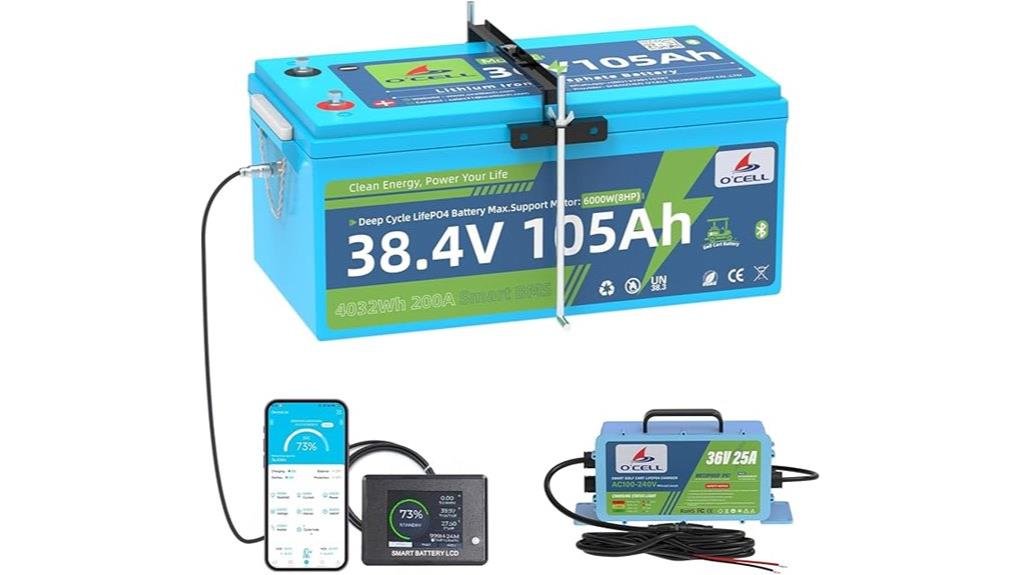
You’ll get a direct‑swap 36V LiFePO4 pack (38.4V nominal, 105Ah, 4.032 kWh) that sustains up to 6,000W continuous with ~2C discharge and 320A peak, so torque and voltage hold under heavy loads. It’s ~50% lighter than lead‑acid, includes a Smart 200A BMS with temp, current and cell protections, and fast 43.8V/25A charging for ~4.2 hours. It’s rated ~4,000+ cycles and has low‑temp charge/discharge limits—keep going for full fitment, safety, and maintenance specifics.
Some Key Takeaways
- 36V 105Ah LiFePO4 pack (4.032 kWh) replaces most 36V carts with plug‑and‑play dimensions and mounting points.
- Delivers up to 6000W continuous and 320A peak, suitable for steep hills, heavy loads, and 70 lb‑thrust motors.
- Includes Smart 200A BMS with over‑charge/discharge, short‑circuit protection, cell balancing, and logging.
- Fast charging with 43.8V/25A charger (≈4.2 hours) and expected 4000+ cycles when avoiding deep discharges.
- Lighter than lead‑acid (≈50% weight reduction), IP65 enclosure, but confirm connector polarity, BMS wiring, and terminal torque before install.
Performance Summary: Real-World Power, Range, and Duty Limits for the 36V 105Ah LiFePO4
Expect dependable high-power performance from the 36V 105Ah LiFePO4: at a nominal 38.4V and 105Ah (4.032 kWh) it can sustain up to 6000W continuous output (about 8 HP) with a 2C max continuous discharge and 320A peak, so you can tackle steep hills, heavy loads, or 70 lb-thrust trolling motors without immediate voltage sag. You’ll assess real world range by combining motor load, terrain, and accessory draw; typical mixed-duty use yields predictable mileage when you track SOC. Torque performance remains consistent under high discharge, minimizing voltage collapse and preserving responsiveness for group outings and shared use. These batteries are an excellent choice for golfers looking to upgrade their carts with top gear for electric golf carts.
Compatibility and Plug‑and‑Play Installation for Club Car, E‑Z‑GO, LVTONG, Yamaha, and Others
Most 36V golf carts from Club Car, E-Z-GO, LVTONG, Yamaha and similar manufacturers accept this 36V 105Ah LiFePO4 as a direct replacement, so you can slide it into standard battery compartments without modifications. You’ll find dimensions and mounting points match common trays, and the 50% weight reduction makes handling easier. For reliable plug-and-play swaps, confirm connector compatibility—match polarity, terminal type, and BMS wiring. Installation tips: wear PPE, disconnect OEM batteries, verify voltage, and torque terminals to spec. Join fellow owners for shared wiring diagrams and vendor-tested adapters to streamline your retrofit with confidence. These sturdy batteries pair well with tailored travel cases designed for golfers who need secure and stylish protection during transport.
Charging, Cycle Life, Temperature Limits, and Maintenance Expectations
After you swap the batteries and confirm proper wiring, you’ll want to understand charging behavior, service life, temperature constraints, and routine care to maximize performance. You’ll charge with the supplied 43.8V 25A LiFePO4 charger or a compatible unit; typical 0→100% takes ~4.2 hours. Expect 4000+ cycles and up to a decade of service if you avoid deep discharges. Monitor cold start behavior—discharging is limited below −20°C and charging is disabled below 0°C—so plan operational windows. For seasonal storage, store at ~50% SOC in a cool, dry place and top up every few months to preserve longevity. Consider transporting and storing batteries in a hard-sided travel case to protect them from impacts and moisture.
Safety Features, BMS Behavior, and Low‑Temperature Protection Details
While the battery’s Smart 200A BMS actively monitors cell voltage, pack current, and temperature to prevent unsafe conditions, you should understand exactly how those protections operate and when they intervene. You’ll see over‑charge cutoff at cell limit, over‑discharge disconnect to protect cycle life, and instantaneous over‑current/short protections that isolate the pack. The LiFePO4 battery chemistry gives intrinsic thermal stability; the BMS adds cell balancing and fault logging. Below 0°C it blocks charging; below −20°C it blocks discharging. Thermal throttling reduces allowable discharge current as temperature or pack temperature rises, preserving longevity and safety while keeping you informed.
Who Should Buy This Battery? Buying Checklist, Use Cases, Weight, Warranty, and Charger Inclusion
If you need a drop‑in, high‑power 36V pack for golf carts or similar vehicle and expect long life with low maintenance, this 36V 105Ah LiFePO4 battery is a strong candidate: it delivers 4.032 kWh, 6000W continuous output, 4000+ cycles, IP65 protection, and a Smart 200A BMS (with Bluetooth/LCD monitoring) while weighing about half of equivalent lead‑acid banks and including a 43.8V/25A fast charger.
You should buy it if you run steep courses, heavy accessories, or dual‑purpose RV/marine setups. Checklist: confirm physical fit, BMS compatibility, charger specs, and observe installation tips (ventilation, secure mounts). Expect lower weight, higher resale value, and a manufacturer warranty plus lifetime technical support.
This company also offers a curated selection of golf cart accessories to help you get the most out of your battery and rounds.
Some Questions Answered
Can I Parallel Multiple Batteries for Extended Range?
Yes — you can parallel multiple batteries for extended range, provided you follow battery paralleling best practices and wiring safety. You’ll match voltage, state-of-charge, age, and use equal-length, properly gauged cables with secure, balanced tie-in points. Make certain the Smart BMS settings align, monitor via Bluetooth, and fuse each battery for fault isolation. Do this and you’ll safely expand capacity while keeping performance predictable and supported by the manufacturer.
Is This Battery Compatible With OEM Golf Cart Chargers?
Yes — you can use OEM golf cart chargers if they match LiFePO4 voltage/current specs; charger compatibility is essential. Verify the charger outputs ~43.8V and appropriate current (≤25A provided, or match charger rating). Check connector types match your battery’s plug or be prepared to adapt connectors safely. You’ll also want a charger that respects LiFePO4 charging profile to protect the BMS and secure peak cycle life and safety.
How Long Does Bluetooth Connectivity Range Last From the Battery?
The Bluetooth range is typically about 10 meters (30–33 feet) line-of-sight; walls or metal can reduce it markedly. You’ll get reliable App features within that window for SOC, voltage, and temperature monitoring. If you need longer reach, position your phone near the battery or use a Bluetooth extender. You’ll appreciate consistent connectivity during normal use, and the app’s diagnostics keep your group informed and confident about battery status.
Are There FAA or Airline Transport Restrictions for This Battery?
Yes — you’ll face FAA restrictions and airline limits for this battery. Airlines and the FAA restrict lithium batteries by watt-hours; at 4.032 kWh (4,032 Wh) this exceeds allowed carry-on/checked limits and is prohibited for passenger aircraft. You’ll need cargo transport under dangerous goods regulations with carrier approval, special packaging, documentation, and possibly state-of-charge limits. Contact your airline and a certified shippers’ agent to arrange compliant air freight.
Can the Battery Be Fast‑Charged More Frequently Without Lifespan Loss?
Yes — you can fast charging more often, but it affects cycle impact if thermal management is inadequate. With the included 43.8V 25A fast charger and Smart 200A BMS, you’ll limit cell stress and maintain long cycle life; still expect incremental wear versus conservative charging. Monitor temps via Bluetooth, avoid charging below 0°C, and check warranty implications for frequent fast charging to guarantee coverage and continued manufacturer support.