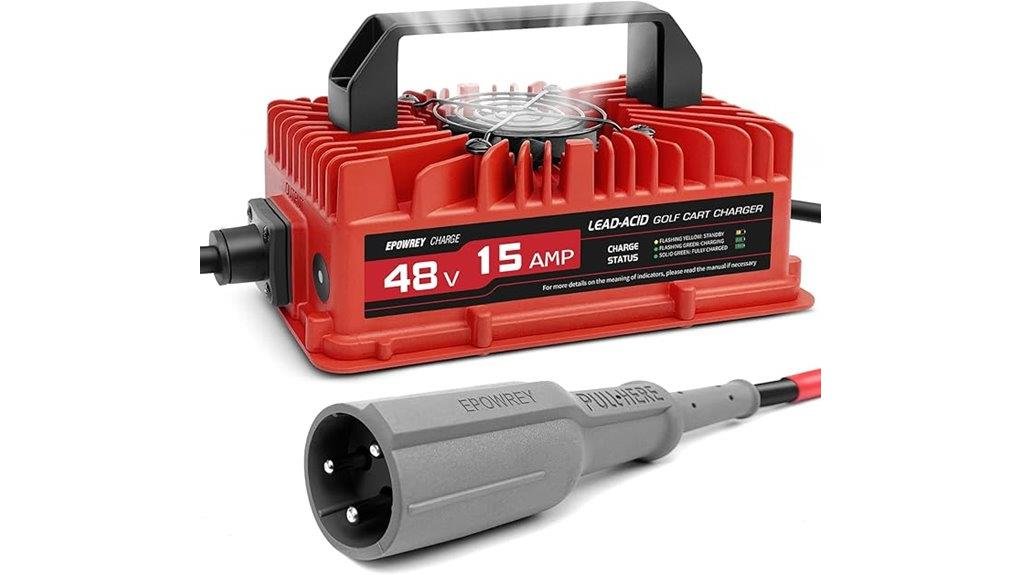
You’ll get a weatherproof 15A 48V charger that fits Club Car 3‑pin round inlets and targets sealed lead‑acid deep‑cycle packs; it negotiates with functioning OBCs or falls back to fixed charging for non‑OBC carts, offers built‑in cell/temperature diagnostics, and smart trickle cut‑off to isolate float when full. The die‑cast aluminum, IP67 enclosure handles field use and washdowns, the 16‑ft cord aids placement, and you’ll want to verify plug mapping and warranty specifics before purchase to learn more.
Some Key Takeaways
- Compatible with Club Car 48V systems using the standard 3‑pin round inlet; confirm plug mapping and polarity before connecting.
- 15A bulk charging reduces recharge time versus typical 5–10A chargers while including smart trickle cut‑off to prevent overcharge.
- OBC handshake supported for carts with functioning onboard computers; includes diagnostics for cell voltage and temperature.
- IP67 die‑cast aluminum housing and sealed connectors provide corrosion resistance and suitability for field use and washdowns.
- One‑year warranty; test promptly, document faults, and consider a separate onboard charger if OBC is faulty or for direct battery access.
Is This 15A 48V Club Car Charger Compatible With Your Cart?
If your Club Car uses a 48V lead-acid system and has the standard 3-pin round charging inlet, this 15A rapid charger will work—its OBC detection handles carts with a functioning onboard computer and it also supports non-OBC 48V Club Car models. You’ll check battery compatibility by confirming voltage, battery chemistry, and terminal arrangement; this charger targets sealed lead-acid deep-cycle packs. Verify plug mapping against your cart’s inlet wiring to avoid miswired connections. You’ll appreciate IP67 sealing and durable case for field use. If your OBC is faulty, plan for the optional separate onboard charger to reach batteries directly. Many golfers also outfit their carts with essential golf cart accessories to improve convenience and protection while on the course.
How Fast and Smart Is the Charging (15A, OBC Detection, Trickle Cut‑Off)?
Having confirmed your cart’s 48V lead‑acid system and inlet compatibility, next look at charging performance: this unit delivers a 15A bulk charge to a 48V pack, which will replenish typical Club Car deep‑cycle batteries markedly faster than standard 5–10A chargers, while its OBC detection negotiates voltage and charge profiles with carts that use an onboard computer. You’ll see reduced charge time; a depleted 48V pack reaches usable state quicker without overcurrent stress. Built‑in battery diagnostics and OBC handshake monitor cell voltage and temperature. Smart trickle cut‑off holds float voltage and isolates power when charge completes. For golfers who travel frequently, pairing this charger with a hard‑sided travel case helps protect both the cart accessories and the charger during transport.
Built Tough: IP67 Weatherproofing and Die‑Cast Aluminum Durability
Because you’ll often leave the charger on a cart exposed to the elements, the IP67 rating guarantees complete dust ingress protection and temporary immersion resistance so rain, mud, and washdowns won’t compromise electronics. You’ll appreciate the die‑cast aluminum housing that resists impacts, disperses heat, and maintains structural integrity over repeated use. Sealed connectors prevent corrosion at critical joints while gaskets preserve the enclosure seal. Thermal management is passive and efficient: metal mass and conductive paths pull heat away from boards, extending component life. This rugged design gives you confidence and community—gear built to endure shared rounds and seasonal storage. Our shop specializes in electric golf cart accessories and parts tailored for golfers who enjoy the game.
Installation, Cable Length, and Real‑World Use Tips for Club Car 3‑Pin Plug
Start by matching the charger’s 3‑pin round plug to your Club Car’s inlet and confirm polarity and OBC compatibility before you connect power. Inspect plug orientation and locking lip; align index marks so pins seat fully. Use the 16‑foot cord to position the unit on a raised, ventilated surface; secure cable routing away from steering linkages, heat sources, and pinch points. For diagnostics, watch LED behavior during first cycle to verify smart trickle and auto‑cutoff. In shared garages, label the charger and cord path so teammates follow the same plug orientation and routing, reducing wear and ensuring reliable everyday charging. Golfers using seated carts often appreciate chargers that support longer ride comfort to help maintain battery health and on-course enjoyment.
Warranty, Alternatives, and When to Choose the Separate Onboard Charger
When you evaluate warranty and alternatives, focus first on failure modes the one-year warranty covers and the response timeline for replacements or repairs so you can decide if a separate onboard charger is warranted. Check warranty transferability—if you sell the cart, transferable coverage preserves value. Test the unit promptly; document faults and use the promised 24-hour support window. Consider alternative brands with longer warranties or modular designs if you need extended uptime. Choose the separate onboard charger when the OBC is unreliable, when you require direct-battery charging for diagnostics, or when faster field-repairability matters to your group. Also consider inspecting the used gear’s overall condition and service history to gauge long-term reliability and compatibility with your cart’s preowned golf gear.
Some Questions Answered
Does It Work With Lithium-Ion 48V Battery Packs?
No, it won’t work safely with 48V lithium-ion packs unless you confirm compatible Battery management and an appropriate Charge profile. You’re designed to match chargers to chemistry; this unit’s lead-acid charge profile and OBC behavior won’t manage lithium cell balancing or cutoff properly. If you want lithium use, get a charger explicitly supporting lithium with BMS communication or fit a compatible external BMS that negotiates charge parameters and protects cells.
Can I Leave It Plugged in During Cart Storage Long-Term?
Yes — you can leave it plugged in during long-term storage if the charger’s smart trickle charging and auto-cutoff are functioning. You’ll maintain battery maintenance, prevent self-discharge, and avoid overcharge when OBC detection or the charger’s float mode works properly. Monitor periodically, confirm green light indicates complete charge, and use the separate onboard charger option if OBC is faulty. We’ll support troubleshooting so you’re confident and included in safe maintenance.
Is the Charger Safe to Use With Aftermarket Battery Monitors?
Yes — you can use it with most aftermarket battery monitors if you check battery communication protocols and monitor compatibility first. The charger’s OBC detection and smart trickle cut-off generally coexist with external monitors, but conflicts can occur if both devices try to control charging. You’ll belong to a safer setup by verifying voltage sensing points, grounding, and that the monitor reads lead-acid profiles. Test and monitor initial cycles to confirm stable operation.
Can I Use an Extension Cord With the 16-Foot Cable?
Yes — you can, but take precautions for extension safety and voltage drop. Use a heavy-duty, grounded extension rated for outdoor use and at least 14 AWG (12 AWG preferred) to minimize voltage drop over the extra length. Keep connections dry and secure, avoid coils that trap heat, and don’t exceed the charger’s current draw. Doing this helps you stay safe, keeps charging reliable, and includes you in responsible gear use.
Does It Come With International Voltage Compatibility or Adapters?
No, it doesn’t include a voltage switch or plug adapters. You’ll need to verify your mains voltage and provide appropriate plug adapters or a step-down/step-up transformer for international use. If your region uses a different socket standard, source grounded plug adapters rated for the charger’s input current. You’ll belong to a practical user group when you document your mains voltage, confirm charger input specs, and test with a multimeter before first use.